While often used interchangeably, Court Marriage is the general procedure of getting married legally under the supervision of a registrar, whereas the Special Marriage Act, 1954 (SMA) is the specific legal statute that enables court marriages for couples regardless of their religion, caste, or creed.
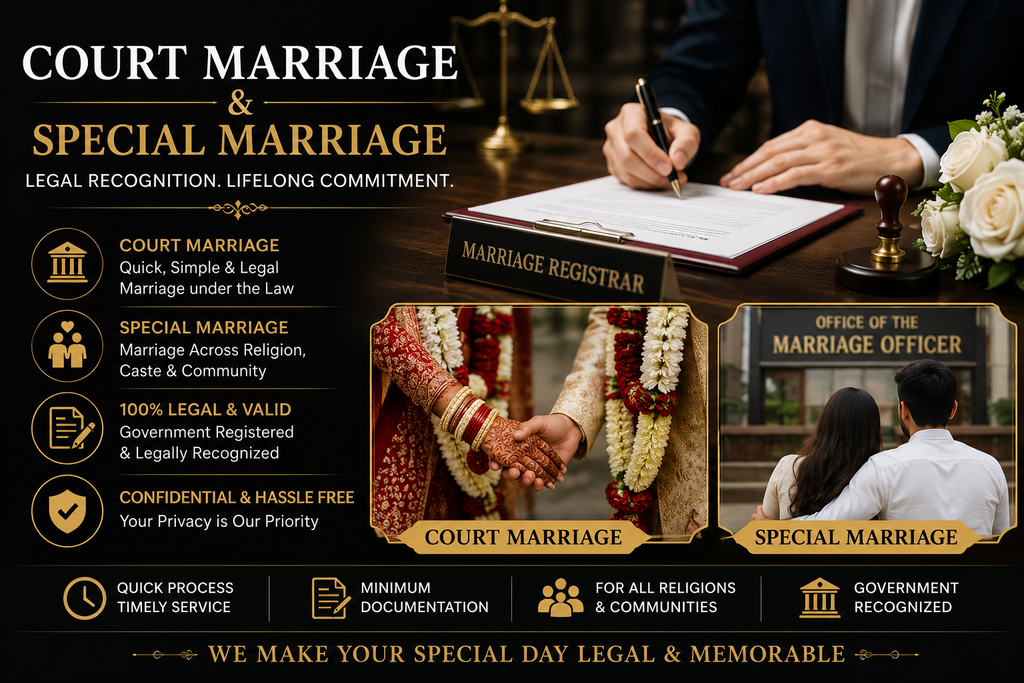
Notice of Intended Marriage: The couple submits a written notice to the Marriage Registrar in the district where at least one partner has resided for at least 30 days prior.
Public Notice & Objections: The registrar posts the notice publicly for 30 days. Anyone can file a legal objection (e.g., existing spouse, age issue, prohibited degrees of relationship).
Solemnization: If no valid objections arise within 30 days, the marriage is solemnized at the registrar’s office.
Signatures & Certificate: The couple, along with three witnesses, signs the declaration. The registrar then issues the official Marriage Certificate.
Mandatory Documents Required
| Feature | Court Marriage (Personal Laws) | Special Marriage Act, 1954 |
| Applicability | Couples of the same religion following specific personal laws (e.g., Hindu Marriage Act). | Couples of different religions/castes, or anyone choosing a secular process. |
| Religious Rituals | Usually requires proof of religious ceremonies (e.g., Saptapadi for Hindus) before registration. | No religious rites required; purely a legal civil solemnization. |
| Notice Period | Minimal notice required if rituals are already performed. | Mandatory 30-day public notice period at the Marriage Officer’s office. |
| Objections | Objections are limited strictly to legal validity under personal law. |